


Closed for Thanksgiving
Thu, Nov 26 to Sat, Nov 28
Reopening Monday, Nov 30. Online quote requests are processed then.

Blog
Beadboard vs V-Groove vs Tongue and Groove

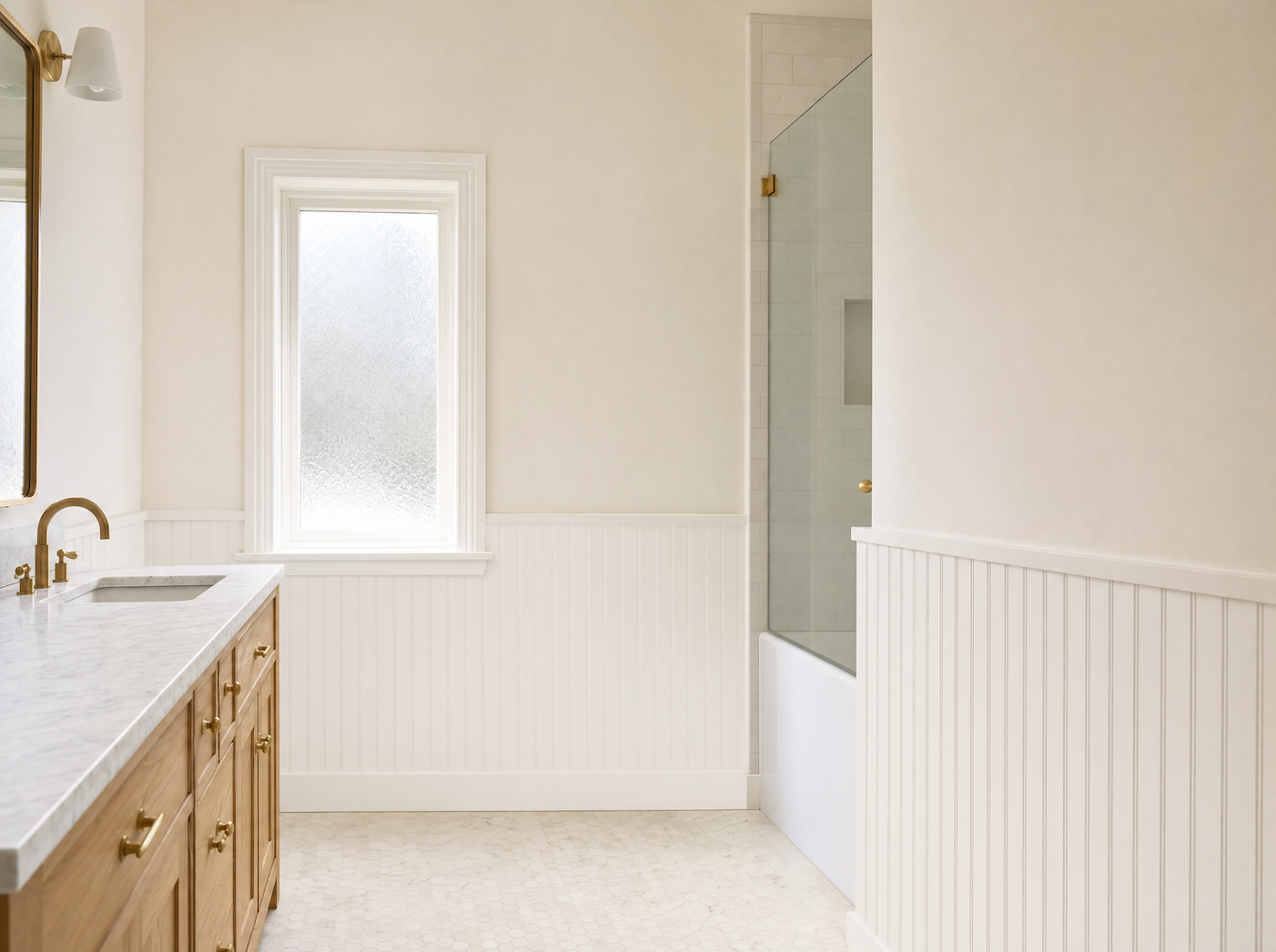
Three terms get used as if they mean the same thing. A homeowner asks for beadboard, a contractor quotes tongue and groove, a designer specifies v-groove, and everyone assumes they are discussing one product.
They are not. Two of those terms describe how a panel looks. The third describes how it is joined together. Sorting that out takes about a minute and saves a great deal of confusion at the order desk.
At The Moulding Company, we have worked with homeowners, designers, and builders on projects of every size, and this is one of the most common mix-ups we untangle. It matters, because the wrong choice shows up on every wall of the room.
This guide explains what each term actually means, where each belongs, and how to choose between them.
The One Distinction That Clears Everything Up
Start here, because it resolves most of the confusion in a single sentence.
Beadboard and v-groove describe the face of the panel, meaning the pattern you see when you look at the wall. Tongue and groove describes the edge, meaning how one board connects to the next.
That means a board can be beadboard and tongue and groove at the same time. It can also be v-groove and tongue and groove. The two categories are not alternatives to each other. They answer different questions.
So when someone says “I want tongue and groove,” the honest follow-up is: tongue and groove with what face pattern?
What Beadboard Is
Beadboard is panelling with narrow vertical boards separated by a small rounded ridge, called a bead, sitting inside each groove.
That bead is the whole identity of the product. It catches light along its length and produces a soft repeated line rather than a hard shadow. The effect reads as traditional, cottage, farmhouse, or coastal depending on what surrounds it.
Historically beadboard was made from individual solid boards, each milled with a bead on one edge and joined edge to edge. Most beadboard sold today is a 4×8 sheet with the pattern routed into the face, which installs far faster and costs considerably less.
Our MDF beadboard panels come in three bead spacings, and the spacing changes the character of the room more than most people expect.

Choosing Your Bead Spacing
Bead spacing is measured on centre, meaning from the middle of one bead to the middle of the next. We stock three:
- Almanor, 1.5 inches on centre. The tightest pattern. Busy and detailed, best suited to small areas such as a powder room, a wainscot below chair rail height, or a porch ceiling.
- Tahoe, 3 inches on centre. The middle option and the safest default. Reads clearly as beadboard without becoming visually noisy across a full wall.
- Mammoth, 6 inches on centre. The widest spacing. Calmer and more contemporary, and the right choice for large walls or full-height applications where a tight bead would overwhelm the room.
A simple rule: the larger the surface, the wider the spacing. Tight beads on a full-height living room wall will feel restless. Wide beads in a small powder room will look unfinished.
What V-Groove Is
V-groove has no bead. Where two boards meet, the edges are chamfered so the joint forms a clean V.
The result is quieter and more geometric than beadboard. There is no rounded highlight, only a crisp shadow line at regular intervals. That makes v-groove read as modern, transitional, or Scandinavian rather than cottage.
V-groove is also more forgiving on ceilings. Because the shadow is a straight line rather than a curve, small variations in the ceiling plane are less obvious than they are under a repeated bead.
If a client wants panelling but flinches at the word farmhouse, v-groove is almost always the answer.
What Tongue and Groove Actually Means
Tongue and groove is a joint. One edge of the board has a protruding tongue, the opposite edge has a matching groove, and the tongue of one board slots into the groove of the next.
It exists for a practical reason. Wood expands and contracts with seasonal humidity, a behaviour the USDA Forest Products Laboratory documents in detail. A tongue and groove joint lets adjacent boards move slightly without opening a gap you can see through, because the tongue stays covered even as the boards shift.
It also makes installation cleaner. Fasteners can be driven at an angle through the tongue and hidden by the next board, so no nail holes show on the face.
Beadboard and v-groove are both commonly milled as tongue and groove when supplied as individual boards. When supplied as a 4×8 sheet, there is no tongue and groove at all, because the pattern is routed into a single continuous panel.
Where Shiplap Fits In
Shiplap gets pulled into this conversation constantly, so it is worth placing.
Shiplap boards have a rabbet, a stepped notch, cut along both edges. The boards overlap rather than interlock, and they are installed with a deliberate small gap between faces. That gap is the look.
Shiplap is therefore neither beadboard nor v-groove nor tongue and groove. It is a fourth thing, defined by an overlapping joint and horizontal orientation.
If a customer asks for shiplap and means “horizontal boards with a visible gap,” that is genuinely shiplap. If they mean “the panelling I saw on television,” they may well want v-groove.
Sheets or Individual Boards
This is the decision that most affects cost and installation time.
Sheets are 4×8 panels with the pattern routed in. They go up fast, cost less per square foot, and produce a perfectly consistent pattern. The compromise is that seams between sheets need planning, and the pattern depth is shallower than milled boards.
Individual boards are milled solid stock or engineered boards, installed one at a time. Deeper profile, more authentic shadow, no sheet seams, and any board can be replaced if damaged. They cost more and take considerably longer to install.
For most interior walls and ceilings, sheets are the sensible choice. Reach for individual boards when the panelling is a feature the eye will linger on, when you are matching existing historic work, or when the run is short enough that labour is not the deciding cost.
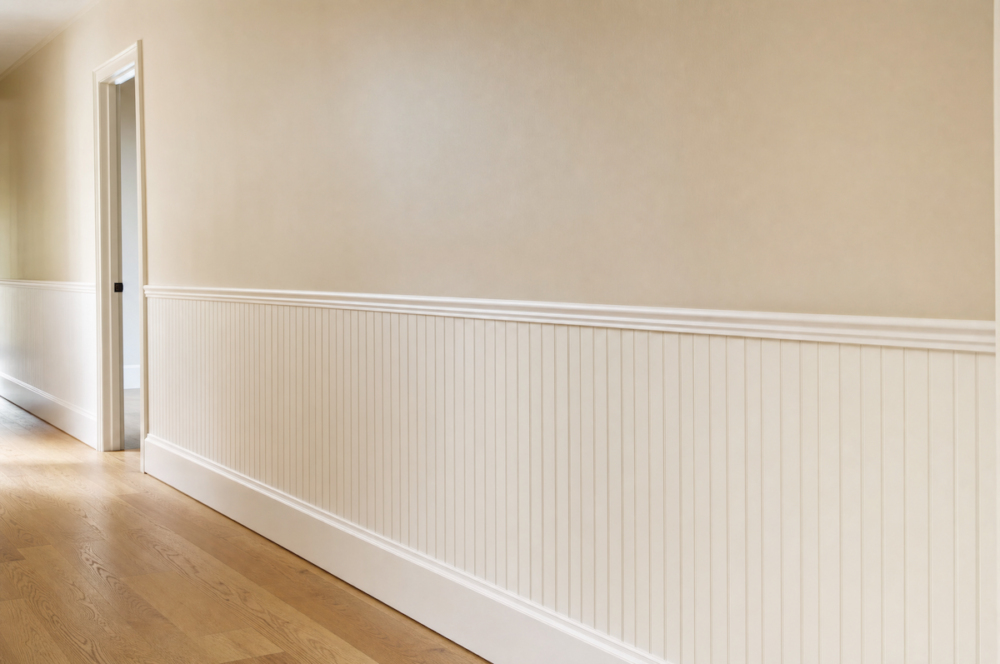
Full Height, Wainscot, or Ceiling
Where the panelling stops matters as much as which panelling you choose.
Wainscot height, running from the baseboard to roughly one third of the wall, is the most common and the most forgiving. It adds texture without committing the whole room, and it protects the part of the wall that actually takes damage. It needs a wainscot cap along the top edge to finish it properly.
Full height suits small rooms, mudrooms, and stairwells, where wrapping the entire wall reads as intentional rather than excessive.
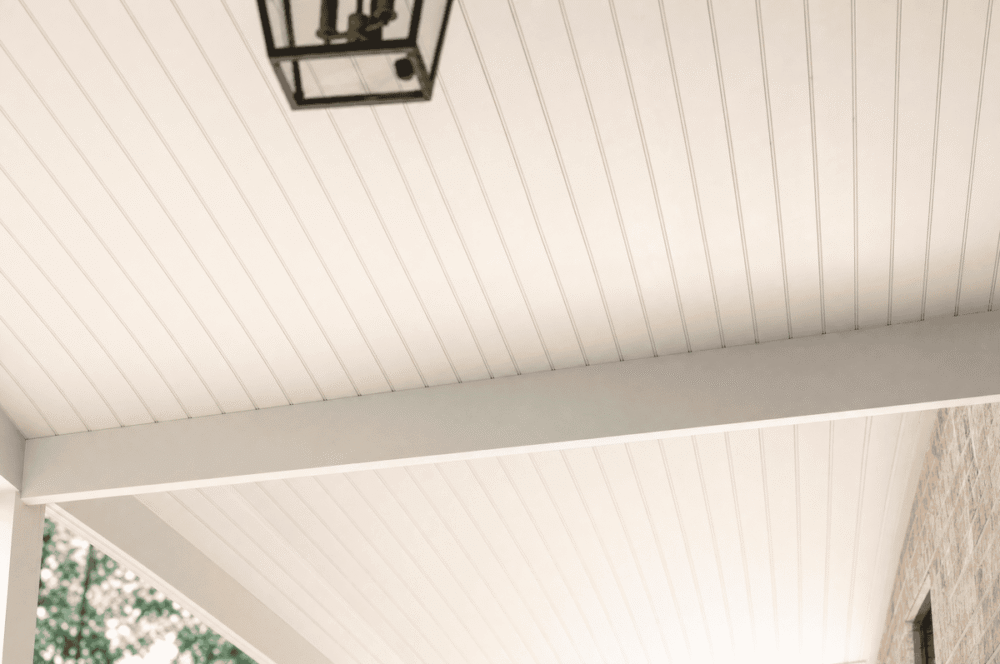
Ceilings are the underrated application. Beadboard or v-groove on a porch ceiling, in a breakfast nook, or over a kitchen island adds character in a plane nobody expects it. Wider spacing works better overhead.
If you are planning panelling as part of a larger scheme, our guide to wainscoting covers how these treatments relate to the rest of the room.
Moisture, Bathrooms, and MDF
MDF beadboard is excellent value and takes paint beautifully, but it has one genuine weakness. It swells when it gets wet, and the swelling is permanent.
That does not rule it out of a bathroom. It rules out installing it carelessly in one. Keep the bottom edge off the floor, seal every cut edge before installation, prime the back as well as the face, and caulk the joint where the panelling meets the floor or tub surround.
For a wet room, a shower surround, a laundry with a floor drain, or an exterior porch ceiling, choose a solid wood or exterior-rated product instead. Our comparison of MDF and wood trim goes through the trade-offs in detail.
Finishing: The Groove Problem
Every one of these products shares the same finishing challenge. The grooves collect paint.
Spraying is the best answer by a wide margin, because it lays an even film into the groove without pooling. If you are brushing, work the groove first with the tip of the brush, then lay off the flat face, and resist loading the brush heavily.
Two thin coats always beat one thick coat here. A thick coat bridges the groove, softens the profile, and undoes the crispness you paid for.
Prime before installation wherever you can. Priming a stack of panels flat on sawhorses is faster and produces a better result than priming them vertically on a wall.
Common Mistakes
- Choosing bead spacing by preference rather than by wall size. Tight beads on a big wall are the most common regret.
- Asking for tongue and groove and expecting a particular look. It describes the joint, not the face.
- Installing MDF panelling tight to a bathroom floor, where the bottom edge wicks water and swells.
- Forgetting the cap. Wainscot height panelling without a proper cap moulding looks unfinished no matter how well it is installed.
- Running panelling to an arbitrary height. Tie it to something, usually one third of the wall or an existing chair rail line.
- Brushing thick paint into the grooves and losing the profile.
How We Help Customers Choose at The Moulding Company
When someone comes in asking for panelling, the first question we ask is what they want the room to feel like, not which product they want.
Cottage, coastal or traditional usually lands on beadboard. Modern, transitional or minimal usually lands on v-groove. From there it is wall size, which sets the spacing, and moisture exposure, which sets the material.
We also make a point of asking whether the panelling is going on a wall, a wainscot, or a ceiling, because the same product behaves differently in each position.
Across our four Bay Area showrooms, we keep panel samples on hand so you can see the bead spacings next to each other. On paper the difference between 1.5 inch and 3 inch sounds small. In person it is obvious immediately.
Final Thoughts
Beadboard and v-groove are two different faces. Tongue and groove is a joint that either one can be built with. Shiplap is a fourth thing entirely.
Once those categories are clear, choosing becomes straightforward. Pick the face that matches the character of the house, pick the spacing that matches the size of the wall, and pick the material that matches how wet the room gets.
At The Moulding Company, we think panelling is one of the highest-impact changes available for the money. It just has to be the right panelling, sized for the right wall.
Frequently Asked Questions (FAQs)
Beadboard has a small rounded ridge, called a bead, inside each groove, which gives it a traditional cottage character. V-groove has no bead. Its boards meet at a chamfered edge that forms a clean V, which reads as more modern and geometric.
No. Tongue and groove describes how boards join together, with a tongue on one edge fitting into a groove on the next. Beadboard describes the pattern on the face. A board can be both beadboard and tongue and groove at the same time.
Use tighter spacing on small surfaces and wider spacing on large ones. Roughly 1.5 inches on centre suits a powder room or a wainscot, 3 inches suits most walls, and 6 inches suits large or full-height walls where a tight bead would feel busy.
Yes, with care. Keep the bottom edge off the floor, seal all cut edges, prime the back as well as the face, and caulk where the panelling meets the floor. For a shower surround or a genuinely wet area, choose solid wood or an exterior-rated product rather than MDF.
No. Shiplap boards have a stepped rabbet along each edge so they overlap with a deliberate gap between faces. Tongue and groove boards interlock and close tight against each other.